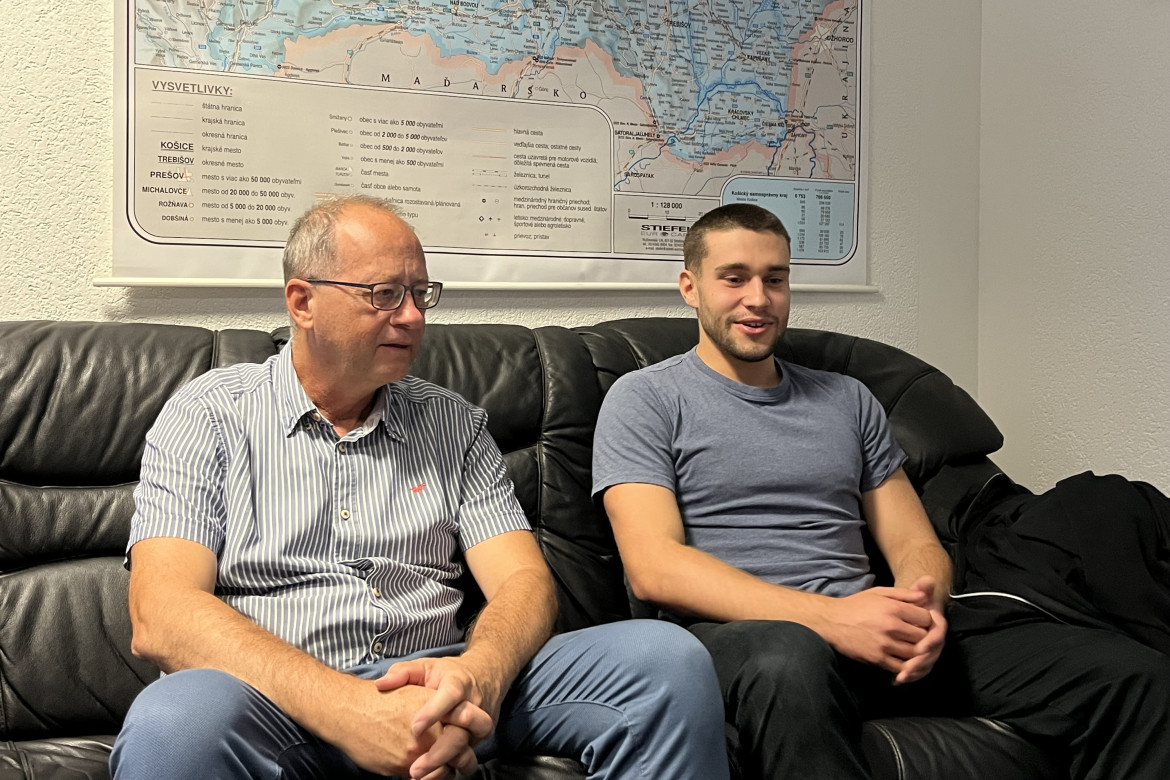
Team of the Data Studio Europe is diverse. People who studied information technology, molecular biology, economic informatics, mathematics, materials physics, production systems management, but also, for example, social work or astrophysics found employment here. During the summer, they were joined by a mathematics student, Daniel Moravec.
Daniel travels quite often. He comes from Prague, studies at the University of Bath, England, and completed a summer internship in the Košice steel mill in the team of Ľubomír Račko.
He enjoyed technical fields from an early age, and since he could not decide which one to prefer, he chose mathematics, the core of all technical scientific disciplines. In England, he studies mathematics with a focus on programming and financial fields. He is in his final year of studies and is facing a decision on where to direct his career.
Why did you decide to do an internship in a manufacturing company?
"Mathematics is quite general, that's why I chose it for my studies. But now I'm considering whether to move towards technology or finance. A year ago, during an internship in the field of finance, I tried programming in accounting. It is a strictly regulated area with little room for creativity. I also wanted to gain experience in the field of technology."
Apparently, artificial intelligence brought you to the steel mill in Košice...
"Basically, yes, last year I had the opportunity to participate in an excursion in USSK, where I heard that an artificial intelligence (AI) system is being applied here. That was the impulse why I asked for an internship with you. At university, we learn AI from a mathematical point of view because AI is basically just a mathematical model. I have a theoretical basis, but I would like to try out how it works in practice. I thought it could be a good opportunity."
How was the month in USSK?
"Very intense. It was in the field of production, with which I have no experience, that I received an extreme amount of information that was difficult to process. But I have already gained sufficient insight into the specific projects I have worked on," adds Daniel. "In the technology sector, I like that specific problems with a specific impact are solved here. And also the cooperation of the team, where graphs are drawn on the boards, various solutions are invented, the whole thing is more open and dynamic."
During our interview, Ľubomír Račko, director of Data Studio Europe, was present, who involved Daniel in several projects. He said that Daniel was most involved in the project of blowing warm wind into the blast furnace, where he helped with data processing. Wind heaters need to be heated and cooled, and Data Studio Europe makes a model for that.
He saw the data in action
Daniel Moravec also saw the production itself. He visited several plants, including the Steelworks, where Data Studio Europe works on models of scrap loading and loading of scrap into troughs.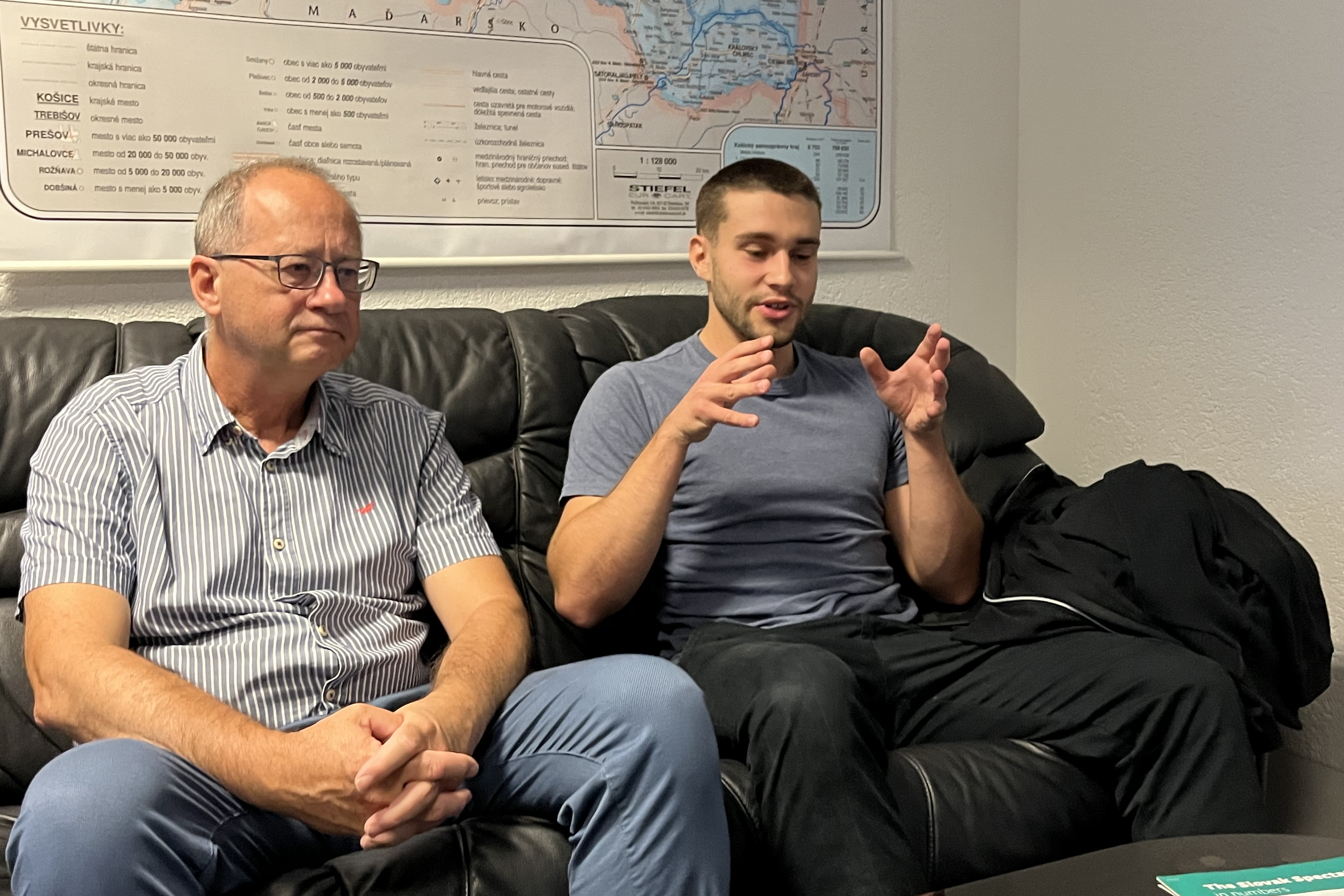
"There I had the opportunity to see how the programming team creates a model for optimizing and implementing a batch. I spent a lot of time in the control rooms, where we talked about the software that is used for production management. I saw where our team was getting their data from. With the blast furnace wind heaters, it was interesting to see the huge towers that our system controls, i.e. the specific physical form of what is happening in the background."
He doesn't leave out his observations either: "I noticed that the system that the developers created was given to the operators to test in production and they immediately knew how to use it, even though from my point of view it looked quite different from the old one. I was right there when the operator saw the new system for the first time and was able to use it within ten minutes. It seems that there must be good communication between developers and operators or line technologists. The programming team understands manufacturing well enough to be able to design a system that is intuitive for the operator."
What surprised you during your internship with us in our company?
"To see a concrete form of what I learn at the university. Which is why important. An example is a camera system that scans scrap in wagons. We created a program that would find out how large parts of the scrap were in the wagons. This is a space where there are segments of material and it is necessary for the photo to be sufficiently focused. I didn't know how to achieve it. In the team, I learned that they use a mathematical method for this, where you can calculate how much the photo is in focus through the second derivatives. This is related to the Laplace transformation. That's what we learned at school, but here I saw a perfect example of how it can be used."
How was the cooperation with colleagues from Data Studio Europe?
Very pleasant. My colleagues helped me a lot, they understood that this area was new to me. If I didn't understand anything, they had no problem explaining it to me more than once, in depth. Ján Tkáčik, my mentor, is able to pass on information in a lecture form, he often drew on the board and explained not only the programming, but also the production process, because he studied both and understands both disciplines very well. It was a good school for me.
What feelings do you leave the internship with?
It gave me a new motivation to study. Now I have an idea of what mathematics is useful for in this sector. I definitely enjoyed it here and at the same time clarified what I want to do in my career – technology definitely attracts me more. The last, demanding year at university awaits me. Then it will be more important what type of work I will do than where it will be.
In the photos: Ľubomír Račko and Daniel Moravec