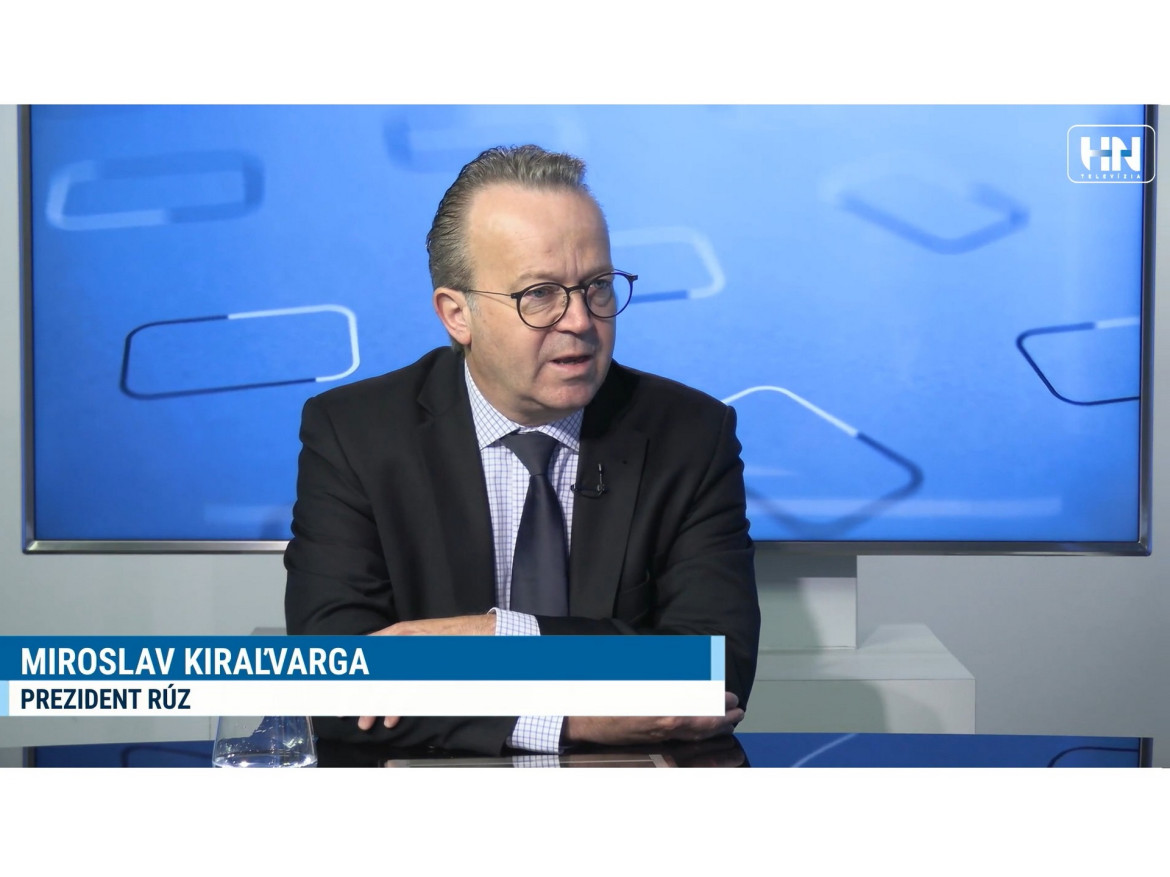
If we do not start consolidating effectively and do not support economic growth, we may be preparing new sets of savings packages, claims the head of the National Union of Employers Miroslav Kiralvarga.
It was only on Wednesday that parliament approved part of the measures from the third consolidation package. These steps mainly impose new obligations on the self-employed, employees, and business owners, and are expected to generate 1.4 billion euros for the state.
How does the state plan to save on itself? We still do not know. While the revenue measures were revealed very quickly, the extent of state spending cuts will not be known until the budget is presented in October.
Employer representatives are appealing to the government to consolidate effectively and, above all, support economic growth. However, this is not happening and the current outlook for the development of our economy also proves them right.
"We don't have any good news. We estimate that growth will be somewhere below 1 percent this year. Next year it will be even worse, around 0.5 percent," assessed NBS Governor Peter Kazimir, adding that our economy could lose up to 30,000 jobs.
HN daily interviewed Miroslav Kiralvarga, president of the National Union of Employers, about the impact of consolidation and its impact on the economy and business environment.
The first measures have already passed parliament. We'll get to them in a moment, but to begin with, how do you assess the first two consolidation rounds?
Slovakia is so indebted that every inhabitant, including all young children, has a debt of more than 14 thousand euros. If we did nothing, our debt would soon increase to more than one hundred billion euros, which would be unacceptable.
Slovakia borrows on the financial markets and we also have to pay interest on each loan. This year alone, we will pay 2 billion. In other words, the monthly interest payment per inhabitant comes to 30 euros. If we continue to borrow, interest will naturally increase.
Therefore, I agree that recovery is necessary. Even more concerning is that, despite two years of consolidation amounting to 4.7 billion euros, the public budget deficit was still expected to remain above 6 billion euros. Despite everything, after two years, we are still in a deficit of 6 billion give or take.
Why, from your point of view, does relatively massive consolidation have no results?
Well, the reason is very prosaic. Firstly, 4.7 billion was calculated on paper, but the reality was clearly lower. And the second thing is that instead of reducing spending, the state spent more. From 2022 to the present, state spending has increased by 40 percent.
This means that if before 2022 spending was at the level of approximately 47 billion, today it is at the level of 67 billion. As a result, we are spending money faster than we are saving it.
The private sector has constantly appealed to the government to start saving on the spending side. In the case of the third package, this is supposed to happen. So are you more satisfied with the current setup?
So far, consolidation has been almost exclusively on the shoulders of employers. We expected that the third package would be mainly about reducing state spending. That did not happen. Again, the majority of it is built on increasing taxes and contributions. After all, employees and entrepreneurs will shoulder more than half of the 2.7 billion euros, contributing 1.4 billion euros.
Some are prematurely congratulating themselves on presenting a supposedly brilliant package. It would be so if it finally supported economic growth. This would mean that we would earn more money on the economy side and thus pay higher amounts of taxes and all fees and contributions. Consequently, we would have greater resources and would not have to borrow so much.
Instead, forecasts speak of GDP growth this year at the level of 1 percent, probably even less. Next year, it will probably be a little more than 1 percent. This means that the economy will not support income growth. And so we can expect to see other measures soon.
How do you view the fact that government officials have a precise idea of who to collect money from and how, but in the meantime it is still not known how they want to save on expenses?
We pointed this out at the Economic and Social Council meeting, which was basically a week after the package was presented. We saw clearly given steps on the side of increasing income from employers and entrepreneurs. On the other hand, however, we only have a declared amount of 1.3 to 1.4 billion, which is to be obtained on the side of savings.
We will learn more about the planned savings only when the state budget is presented, which should be no later than October 15. We are hearing about freezing salaries, suspending purchases of certain items. Do you have at least a rough idea of what the spending cuts will look like?
It must be said that if we freeze salaries, we cannot talk about savings.
We can probably expect that the need to raise frozen salaries will come sooner or later.
Exactly. History has taught us that if salaries were frozen somewhere in the past, they grew in a year or two. We cannot call this savings, but rather temporary cost avoidance. At the Economic and Social Council, we declared that we do not see how these savings are to be achieved.
If we really want to reduce the number of employees working in state and government institutions, we need to launch a personnel and process audit in order to have tangible results, which is the most effective and best way to do it in a way that achieves the desired benefit.
From our experience in the business sector, this process often takes half a year, sometimes up to a year. Therefore, I ask how we will achieve a reduction in the number of employees if the audits are still not underway? Will we see the results at all in the spring?
In addition, the savings on expenses include a 400 million package for energy assistance, which is to be covered by European funds. Isn't this literally burning money that should have been intended for development?
If these funds are actually used for energy assistance, the state has already saved a third, because these funds will not be spent from the state budget. However, as you rightly say, the purpose of using this money is to support investments. They are to increase the quality of life of the citizens of the member state and support economic growth. We should not eat them up.
Moreover, if energy policy within the European Union does not change, there is nothing to indicate that energy prices will fall rapidly. This problem will therefore be here next year and the following years.
Have you tried to communicate with the state and help it find solutions on how to save on expenses?
Yes. Repeatedly. However, we always received the answer that as soon as a political agreement is reached, they will let us know.
And they did. Except that they informed the entire public about everything first.
Basically, they just repeated the scenario from the previous year, which was definitely not good. The argument was that the employer representatives and the unions cannot agree.
Paradoxically, however, an unprecedented situation occurred when you actually agreed.
It did. However, I will leave that for the second part of the debate. In any case, we did not expect a consensus when preparing the package.
Apparently, you at least expected to be heard.
We could have met repeatedly since the beginning of the year. We could have reached partial conclusions that would have been supported by the social partners as a single bloc. We cannot agree on this, but unfortunately, someone has to give way, the other side gives way and we would have come up with some conclusion. But they left us out of it.
I caught one absurd argument from the Government Office, where I quote that you would "not even agree". But let's imagine that a meeting would take place. What proposals would you and the trade unionists come up with? What would be different from what we see today?
In May, we, as the National Union of Employers, together with the Confederation of Trade Unions, reached an agreement. In May, we presented seven areas to the Ministry of Finance that talked about the effective management of state and public administration or about reducing spending by the state and public institutions. Altogether, these were measures worth more than 2 billion euros.
Anyone can question us and call these proposals unrealistic. But we are talking, so prove us wrong. Let's talk, but not on September 16, when everything has already been decided.
Why do you think this communication? Is there a fear on the government's part that the measures would be revealed in advance, which would sabotage their original plans to carry out the entire consolidation?
I will follow up on the phrase fear of revealing the measures. After all, what is the current situation better for? There is currently a stormy discussion about each and every measure and some of the speeches of the deputies are really viewed badly.
I am sad that we have reached a stage in the development of society, at least in Slovakia, when we do not argue based on facts and data, but on interpretations. Who, how, what will say and this is the basis of argumentation and the basis of counter argumentation for us.
Numbers are not accepted, they are questioned. Facts are not accepted, but interpretation is pushed. All this is not aimed at preventing populism from winning, or at preventing deception.
The task of the Economic and Social Council is to comment and provide comments on the draft law or amendments to laws on the part of the social partners. We are trying to follow the facts. This is why, as the National Union of Employers, we submitted eight pages of expert arguments addressing the 22 draft measures, explaining our dissatisfaction and why we cannot agree with such a procedure.
Are we currently at a dead end? From your point of view, will we consolidate in this way indefinitely?
The goal is probably to reach a stage where we comply with the Maastricht criteria, based on which the deficit should be a maximum of 3 percent. Now we are at 5 percent or more, so we have a long way to go. That is why we repeat that economic growth needs to be started.
Increasing income is the only way to make money. The state and its employees will not make money. It will be made by entrepreneurs, employers and employees in private companies. They are responsible for ensuring that we as a society can function, including all social and health expenses.
The problem is that compared to neighboring countries, we are in the worst shape. So investors logically look at whether this is the country where they really want to invest. I would like Slovakia to be more attractive.
If we look at the data, in the years 2000 to 2010, foreign investments were at the level of 6 percent of gross domestic product. In 2013 to 2022, it was only at the level of 2 percent. Subsequently, in 2023 it was zero. And if we burden work and increase the costs of entrepreneurs, the current situation will not change.
After all, the fact speaks for itself that if we compare the average income of an employee in Slovakia with surrounding countries and include housing costs and the entire consumer basket for living, Poland has a net income 56 percent higher than in Slovakia. The Czech Republic has a net income 35 percent higher and Hungary 22 percent higher than here.
If a young person hears this, how will he decide?
Several experts have claimed that the losers are mainly self-employed people. Do you agree?
Personally, I agree that if a self-employed person expects to have the same income from the Social Insurance as any employee, he must realize that he must pay comparable amounts during his active life and active work.
However, as a result, we see that employees who worked in an employment relationship contribute to the pensions of self-employed people. Therefore, I am in favor of making a change in this unsystematic approach as well. On the other hand, we want to support trades and entrepreneurship of individuals and small companies. Once again, we are getting to the point where an expert discussion should have taken place.
How has the latest package affected employers from your point of view? Will they be affected, in particular, indirectly by the increase in health contributions for employees?
Before presenting the measures, we issued a press release that increasing levies is not a good step. The tax and contribution burden in our country is already high anyway. However, we learned that the health insurance contribution from the employee will be increased by 1 percent.
The employee will see a lower amount on his paycheck and we can logically expect that he will pressure the employer to increase wages. He will want his money back, so he will expect his income to increase in the form of a higher salary.
In recent years, Schaeffler has built research and development facilities in Kysuce, ZF in Trnava and Haleon in Levice. This was proof that we do not have to be just an assembly workshop. On the other hand, it is much more expensive to employ talents here than in the Czech Republic, for example. Is there a risk of their outflow?
Eurostat data shows that the average net income of a university-educated employee in Slovakia reached 12,000 euros last year. This is the lowest of all EU countries. In Hungary and Romania it is 1,000 euros more. In Bulgaria and Poland it is 4,000 euros more. In the Czech Republic it is 9,000 euros more.
This figure means that although we have university-educated people, many of them do not work in a field that will bring them an adequate income. At the same time, the tax and social security burden plays a significant role, which is extremely high and causes such large discrepancies.
How can we learn from the steps taken so far and what can be done in the future to avoid problems and achieve our goal?
Very simply. First, any draft measures, including consolidation measures, should be prepared first from a professional perspective, and then a political agreement should come. Not the other way around. We are ready to participate in the first part with the aim of finding the most effective consolidation package, because we need it.
Secondly, it is necessary to realize that without effective consolidation and growth, we will also need a package for 2027. If we do it similarly to 2026, we will need a package for 2028. So I call on all possible interested social partners who are interested in participating in this topic, let's open possible measures for 2027 today. Let's prepare them together so that they are accepted by the whole society, including employers, employees and government representatives.